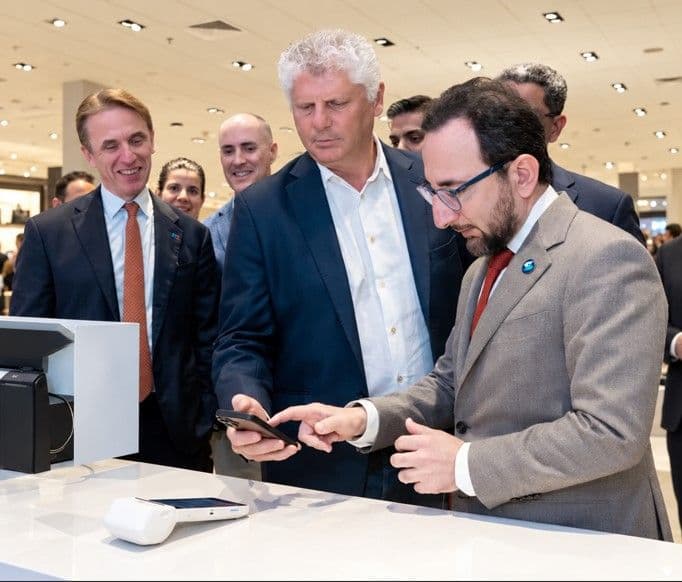
Network International has started an in-store payment pilot that allows shoppers in the United Arab Emirates to pay with DDSC, a regulated stablecoin tied to the UAE dirham, through existing point-of-sale terminals.
A routine trip to the supermarket or department store is becoming a test of how regulated digital currency might fit into everyday retail. Network International said that it had begun an in-store DDSC payment pilot at selected UAE locations, describing the project as the first initiative of its kind in the country.
The pilot took place at the Marks & Spencer branch operated by Al-Futtaim at Dubai Festival City and at LuLu Hypermarket in Khalidiyah Mall, Abu Dhabi. Rather than installing an entirely separate checkout system, participating retailers are using Network International’s existing point-of-sale infrastructure to process the transactions.
Saifee Rupawala, CEO, LuLu Retail, said: “At LuLu, we believe the future of retail will be shaped by how seamlessly technology enhances the customer experience. We are proud to be among the first retailers in the UAE to enable this pioneering payment solution, reinforcing our commitment to innovation and supporting the UAE’s vision for a world-class digital economy.”
Eric Shehadeh, group director of financial services at Al-Futtaim, added: "Handling tens of millions of customer payments a year across Al-Futtaim’s 200+ brands, we know what real adoption requires. Bringing Dirham-backed stablecoin acceptance to that footprint is how innovation moves from pilot to everyday, advancing the UAE's digital economy."
Customers with a supported wallet can select DDSC as their payment method at checkout. The terminal displays a QR code, which the shopper scans with the wallet to authorize the purchase. Once the transaction is confirmed, the retailer receives a notification through Network International’s existing acceptance system.
Settlement is available in either DDSC or conventional UAE dirhams, depending on the arrangement between the merchant and the payment provider. A retailer choosing the stablecoin option receives the funds in a supported DDSC wallet, while another merchant can continue settling in fiat currency.
A Regulated Dirham-Backed Token
DDSC is designed to maintain a one-to-one value with the UAE dirham. Unlike a cryptocurrency whose market price moves freely, the token is intended to track the value of the national currency.
The stablecoin was established through a collaboration involving International Holding Company, First Abu Dhabi Bank and Sirius International Holding. The Central Bank of the UAE approved DDSC to go live as a regulated dirham-backed stablecoin earlier in 2026.
Network International said DDSC is licensed under the Central Bank’s Payment Token Services Regulation and backed by a segregated reserve of assets maintained under the applicable regulatory framework.
Transactions settle on ADI Chain, an institutional Layer 2 blockchain developed by the Abu Dhabi-based ADI Foundation. IHC originally presented DDSC as infrastructure for institutional and government-related applications, including payments, treasury operations, settlement and trade flows. Its use at retail checkouts represents a move into a more consumer-facing setting.
Ajay Hans Raj Bhatia, CEO of Sirius International Holding, said: “Our collaboration with Network International is a defining step in bringing digital assets into everyday life. By enabling DDSC, a dirham-backed stablecoin, to work seamlessly through established payment infrastructure, we are turning the promise of digital currencies into a practical reality for businesses and consumers. This is about more than payments, it is about building the next generation of trusted, regulated and accessible financial infrastructure for the UAE and beyond.”
From Pilot to Wider Adoption
The pilot brings blockchain-based settlement into familiar retail locations without asking stores to replace their established payment terminals. From a customer’s perspective, the process resembles other QR-code payment methods. Behind the transaction, however, value moves through a regulated token rather than solely through card networks or conventional bank-account rails.
Network International said it plans to expand DDSC acceptance across its UAE merchant network after testing is completed.
Murat Cagri Suzer, group CEO of Network International, said: “We are proud to be one of the building blocks of this important milestone in the evolution of payments in the UAE. Through our partnership with DDSC, Network International merchants will be able to accept payments in DDSC and have the flexibility to settle in stablecoin.Network International serves clients across 56 countries, and we continue to build technologies that make payments increasingly seamless and borderless.”
Retail participation gives the companies an opportunity to examine questions that cannot be answered by a technical demonstration alone. Customers must have access to compatible wallets and be willing to hold DDSC, while merchants need settlement, accounting, refund and reconciliation processes that work reliably during normal store operations. Consumer demand and operating economics will ultimately influence whether the payment method moves beyond selected branches.
UAE Builds Out Regulated Digital Payments
The trial arrives as UAE authorities continue developing rules and infrastructure for digital payments. The Central Bank of the UAE is responsible for maintaining the stability of the national currency and overseeing the country’s monetary system, while its payment-token framework establishes requirements for regulated token-based services.
DDSC is not a central bank digital currency issued directly by the monetary authority. It is a privately developed payment token backed by dirham-denominated reserves and licensed under the central bank’s regulatory framework.
Using existing retail terminals gives the project a practical route into everyday payments without requiring merchants to replace established checkout systems. Wallet availability, straightforward redemption, reserve transparency and consumer awareness could help support broader adoption as the pilot develops.