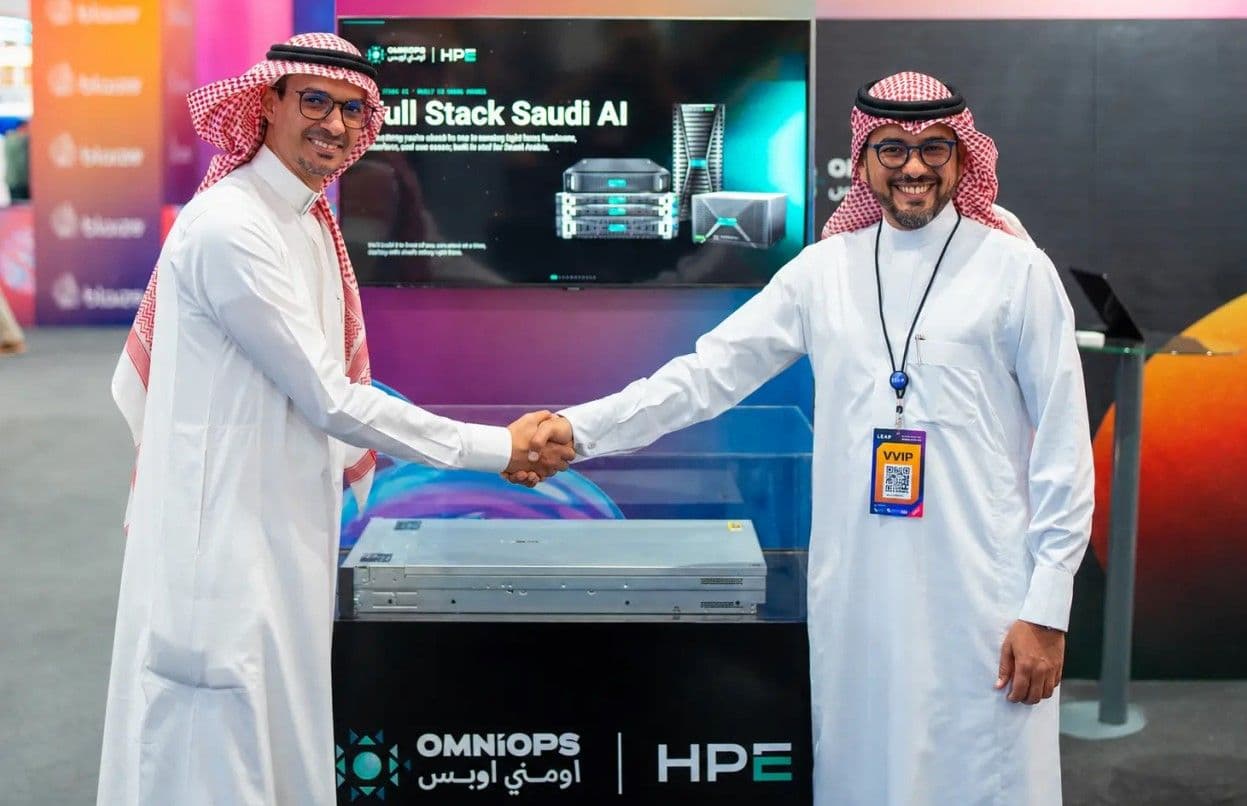
Saudi artificial intelligence infrastructure company OmniOps and Hewlett Packard Enterprise have signed a memorandum of understanding to explore sovereign AI systems built and operated in Saudi Arabia, according to a press release shared with Finance News International.
The proposed collaboration would combine locally manufactured HPE computing infrastructure with OmniOps’ Saudi-developed AI platform and domestic deployment capabilities. Government agencies and businesses are the intended customers, although the companies have not disclosed participating organizations, financial terms or a timetable for commercial availability.
Agreement Centers on a Saudi Technology Stack
Under the memorandum, the companies plan to develop systems in which the physical servers, supporting infrastructure and AI-management software are produced or operated within Saudi Arabia. The approach is intended to give customers greater control over where data is stored, where computing takes place and which entities manage the underlying technology.
HPE is contributing infrastructure associated with its “Saudi Made” localization program, while OmniOps would supply its software and in-country implementation capabilities. The companies said the arrangement is aligned with an expanded “Saudi Made, Developed and Deployed” initiative, which places additional emphasis on domestic technology development and operation rather than hardware assembly alone.
The collaboration is also intended to help organizations move AI projects beyond limited trials and into operational use. OmniOps and HPE plan to validate, deploy and support the proposed systems within Saudi Arabia, keeping more of the implementation process under the Kingdom’s jurisdiction.
Bunyan Provides the Software Layer
OmniOps said its role in the proposed stack would center on Bunyan, an AI inference and management platform designed to operate across public clouds, private infrastructure, customer premises and isolated or air-gapped environments. The platform includes an inference hub and an AI studio for managing models, application programming interfaces, AI agents and automated workflows.
Hardware flexibility is another component of the proposal. OmniOps says Bunyan is designed to work with computing technology from multiple vendors, potentially allowing customers to adopt locally produced HPE servers without being restricted to a single provider across every part of their AI infrastructure.
Regulated organizations often examine more than the physical location of stored information when evaluating AI systems. Deployment architecture can also determine who administers the platform, whether information travels outside a controlled environment and how easily an organization can inspect or change the components supporting its workloads. The planned OmniOps-HPE work addresses those infrastructure questions.
Executives Emphasize Local Control
Mohammed Altassan, founding CEO of OmniOps, said: “Today, our customers across government, aviation and financial services require more control and transparency. Running our own software on servers produced here in the Kingdom means we can answer all three of their immediate needs: where their data sits, who built the platform running on top of it and where the hardware underneath it comes from. That is what a genuinely sovereign stack looks like, and it is what the National Strategy for Data and AI was built to enable."
Mohammad Alrehaili, HPE’s vice president and managing director for the Middle East, added: “This collaboration with OmniOps brings the vision of Saudi Made, Developed & Deployed to life and will give organizations in Saudi Arabia a strong foundation for deploying sovereign AI at scale. Together we will help accelerate AI adoption and support the continued growth of the Kingdom’s technology ecosystem.”
The executives’ comments frame sovereignty as a combination of data residency, domestic operations and greater visibility into infrastructure. Actual levels of customer control will depend on the architecture and contractual terms of future deployments, including model access, administrator privileges, cybersecurity controls, software dependencies and arrangements for maintenance and support.
Saudi Arabia Expands Its AI Infrastructure
The agreement comes as Saudi Arabia increases investment in computing capacity and seeks a larger role in artificial intelligence development. In 2025, the kingdom established Humain, a Public Investment Fund-owned company focused on data centers, cloud infrastructure, AI models and related services.
Infrastructure localization has become part of that broader effort. Organizations handling government, financial or commercially sensitive information may prefer or, depending on applicable rules and contracts, require systems that keep workloads within the country. Local deployment alone does not resolve every question surrounding security, privacy or operational independence, but it can provide a foundation for meeting data-residency and oversight requirements.
OmniOps and HPE now face the task of translating their memorandum into a defined technical and commercial offering. The next phase could establish how HPE’s locally produced infrastructure will integrate with the Bunyan platform, along with the deployment and support arrangements available to customers.